What Klarna's AI Did in 30 Days — And What Broke
Klarna's AI handled 2.3M chats in month one — 700 agents' worth. Resolution dropped 82%. What they built, what broke, what to replicate.
Key Takeaways
- ✓Klarna's AI handled 2.3M chats in month one (Feb 2024 launch)
- ✓Resolution time dropped from 11 minutes to under 2 minutes
- ✓AI handles ~two-thirds of chats; by Q3 2025, 853 agents of work and ~$60M saved
- ✓In May 2025 Klarna began rehiring humans and walked back the "700 agents" framing
- ✓You can replicate the approach with Twig or similar platforms
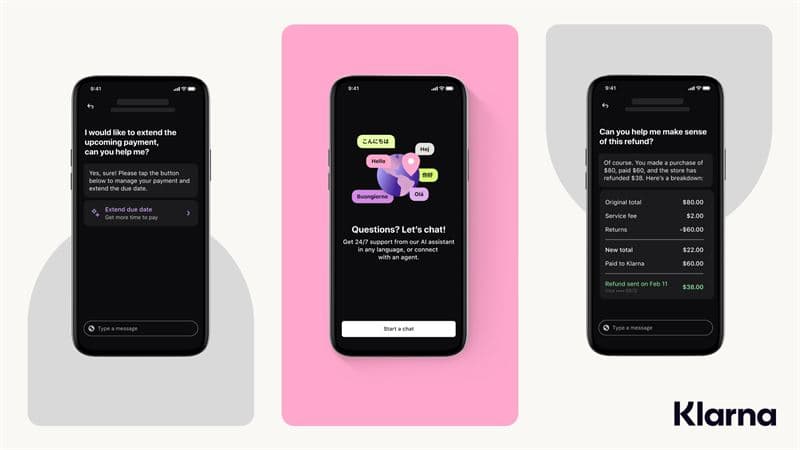
Klarna's AI customer service assistant, launched February 2024 in partnership with OpenAI, became the most-cited reference deployment in fintech support. The numbers are striking: 2.3M chats handled in month one, 2/3 of all customer conversations automated, resolution time down from 11 minutes to under 2 minutes.
But the Klarna AI story has a second chapter that doesn't get discussed as often — by 2025, Klarna publicly walked back some of its AI-only claims and reintroduced human agents for complex cases. That second chapter is the one worth learning from.
This guide covers exactly what Klarna built, how it performed, what broke, and how you can apply the lessons to your own support operation.
TL;DR: Klarna's AI is one of the most ambitious customer support deployments ever. It works, but not as a full replacement for humans. The real lesson is around guardrails, escalation quality, and knowing what AI shouldn't do autonomously.
What Klarna's AI Assistant Actually Is
Launched: February 2024 Partner: OpenAI (GPT-4-class models) Channels: In-app chat, web chat, help center Languages: 35+ Volume: 2.3M chats in month one
Klarna's assistant reads incoming customer messages and handles the full conversation — answering questions, looking up account details, processing refunds, and scheduling payments — without a human agent in the loop for the majority of cases.
Under the hood, it's a tightly integrated system combining:
- A GPT-4-class language model
- Direct integration with Klarna's account and transaction APIs
- A knowledge base of Klarna policies and FAQs
- Escalation logic that routes complex cases to human agents
The Results Klarna Published
From their Feb 2024 announcement and 2024 earnings reports:
| Metric | Before AI | After AI |
|---|---|---|
| Chats handled by AI | 0% | 67% |
| Average resolution time | 11 minutes | under 2 minutes |
| CSAT | Baseline | On par with human agents |
| Multilingual support | Limited | 35+ languages |
| Cost savings (estimated) | N/A | $40M/year |
The $40M number comes from Klarna's estimate that the AI assistant is doing "the work of 700 full-time agents." That framing made headlines — and also became the piece Klarna later had to walk back.
Where Those Numbers Are in 2026
The launch figures held up as Klarna scaled. Its most recent public update (Q3 2025) put the AI at the work of 853 agents (up from 700) and ~$60M in annual savings (up from $40M), with response times 82% faster than pre-AI and a customer NPS of 73. The efficiency story kept compounding — but so did the quality problems, which is why Klarna started hiring humans back in May 2025 (next section).
What Went Wrong
In May 2025, Klarna publicly reversed course and started rehiring human agents — CEO Sebastian Siemiatkowski conceded that cost-driven automation produces "lower quality" and promised customers will "always [have] a human if you want." The reasons, based on public statements and industry reporting:
1. Complex cases degraded CSAT. For simple queries (order status, payment schedules), AI matched human performance. For complex disputes, fraud claims, and hardship cases, AI resolution quality dropped noticeably.
2. Hallucinations on edge cases. The model occasionally gave confident-but-wrong answers about policy, fees, or payment terms. In fintech, wrong answers about money are a compliance problem, not just a CSAT problem.
3. "We replaced 700 agents" was misleading. Klarna wasn't replacing 700 agents with AI — they were avoiding hiring 700 new agents during a growth phase. The framing implied layoffs that didn't actually happen.
4. Customer preference for humans on sensitive issues. Even when AI gave correct answers, some customers wanted a human for sensitive financial matters and rated the AI-only experience lower.
Klarna course-corrected by:
- Re-introducing human agents for complex case types — piloting flexible, remote roles in an "Uber-type" staffing model
- Adding stricter confidence thresholds before AI auto-responds
- Refining escalation logic to hand off to humans faster on ambiguous queries
Lessons You Can Apply
Here's what matters for any team deploying AI customer support, based on Klarna's experience:
1. Segment queries by risk, not just by volume
Klarna initially pointed AI at all chat volume. The better approach: classify queries by risk band (informational / account-specific / high-stakes regulated) and only automate the lower-risk bands fully.
2. Set strict confidence thresholds
AI should refuse to answer when confidence is low. The instinct is to tune for high automation rate; the better instinct is to tune for high quality of the automated subset. A 50% automation rate with 98% accuracy beats a 75% automation rate with 90% accuracy in regulated contexts.
3. Invest in escalation quality
When AI escalates to a human, the handoff needs to include classified intent, retrieved context, attempted response, and confidence score. Klarna reportedly had weak escalation handoffs initially — customers had to re-explain themselves, which tanked CSAT on escalated tickets.
4. Don't frame it as "AI replaces agents"
Internally and externally, frame AI as "agents work higher up the value chain." Your best human agents should be solving the hardest 20% of cases, not the easy 80%. That's worth celebrating, not hiding.
5. Audit hallucinations weekly
Pull a sample of 100 AI-handled conversations every week and review. Look for:
- Policy claims that don't match your actual policies
- Dollar amounts, dates, or account numbers the AI invented
- Tone misses (dismissive, robotic, overly casual)
Fix content gaps that caused the hallucinations; don't just prompt-engineer around them.
Can You Replicate Klarna's Approach?
Yes — but with important qualifications.
What Klarna had that you probably don't:
- Direct OpenAI engineering partnership
- Full control over their APIs and data
- Willingness to launch publicly and iterate on feedback
- 85M+ active consumers to justify custom engineering
What you can use instead: Platforms like Twig productize the same pattern Klarna built custom:
- GPT-4-class language model handling incoming conversations
- RAG pipeline that grounds responses in your knowledge base
- Confidence-based routing (AI answers when sure, escalates when not)
- Integration with your existing helpdesk (Zendesk, Intercom, Freshdesk)
- Audit trails for every AI decision
The difference: you don't build the platform, you configure it. Deployment takes weeks, not quarters.
See how Twig replicates Klarna's playbook →
Practical Replication Steps
If you wanted to build a Klarna-style AI support assistant for your company:
Step 1 — Audit your content. The AI is only as good as your help docs and past ticket data. Clean these up first.
Step 2 — Classify query risk. Tag every ticket type as low / medium / high risk based on business impact if the AI gets it wrong.
Step 3 — Pick a platform. Custom build if you have a large engineering team and specific needs. Platform (Twig, Intercom Fin, Decagon) otherwise.
Step 4 — Deploy in human-review mode first. Every AI response gets reviewed by a human before sending for the first 30 days. Track override rate — target below 5% before going fully autonomous.
Step 5 — Deploy autonomously on low-risk queries only. Gradually expand the autonomous scope as confidence grows.
Step 6 — Monitor hallucinations weekly. Sample 100 conversations, audit, fix content gaps, iterate.
Klarna's Specific Numbers — Context
When Klarna says AI is doing the work of "700 full-time agents," here's the math:
- 2.3M chats per month
- Assume avg handle time for a human: 11 min
- 2.3M × 11 min = 25.3M min/month = 421K hours/month
- 421K hours / 160 hours per agent per month = ~2,630 agent-hours worth of work
At 67% automation, AI handles ~1,760 agent-equivalents of work. The "700 FTE" figure reflects the ongoing hiring they avoided during a growth phase, not 700 human agents displaced.
Either way, it's the largest public AI customer support deployment we've seen.
Common questions are answered in the FAQ below.
Get your own AI Receptionist now
Free 15-day trial · From $49/mo · No credit card
Frequently Asked Questions
What is Klarna's AI assistant?
A GPT-4-class AI customer service assistant launched February 2024 in partnership with OpenAI. It handles about two-thirds of Klarna's customer chats across 35+ languages.
How much did Klarna save with AI customer support?
Klarna estimated ~$40M in annual cost avoidance at launch; by Q3 2025 it reported ~$60M and the AI doing the work of 853 agents. The savings come from avoiding hires during growth, not from layoffs.
Did Klarna's AI replace human agents?
Not in the literal sense, and by May 2025 Klarna began rehiring humans for complex cases, moving to an "Uber-type" model where a human is always available. It avoided hiring new agents but did not lay off existing staff.
Can I build an AI assistant like Klarna's?
Yes, using platforms like Twig that productize the same pattern Klarna built custom with OpenAI. Expect weeks of setup, not quarters, plus real time invested in content cleanup.
What went wrong with Klarna's AI customer support?
Complex cases degraded CSAT, hallucinations appeared on edge cases, and the "replaced 700 agents" framing was misleading. Klarna course-corrected in May 2025 by rehiring humans and tightening AI confidence thresholds.
Related Pages
Weekly AI CX insights
How leading support teams deploy autonomous AI. One short email a week.
Related Articles
Decagon vs Sierra vs Twig: Which Is Most Secure?
Twig attaches source attribution and audit trails to every answer. Decagon and Sierra rely on enterprise controls. Which AI support is most trustworthy?
5 min readDecagon vs Sierra vs Twig: Best Helpdesk Coverage?
Twig connects 30+ data sources and runs across helpdesks. Decagon and Sierra favor custom enterprise stacks. Which has the best integration coverage?
5 min readDecagon vs Sierra vs Twig: Which Fits Mid-Market?
Decagon and Sierra are built for enterprise floors. Twig serves SMB and mid-market with no minimums. Which AI support platform fits a smaller team?
5 min read