How Many Support Agents Can I Replace with AI?
Learn how many support agents AI can realistically replace, how to calculate agent savings, and why augmentation often beats full replacement.
Key Takeaways
- ✓AI typically absorbs 30-50% of ticket volume, translating to proportional headcount savings
- ✓The real math depends on your ticket mix, agent utilization, and AI resolution quality
- ✓Augmentation (AI + humans) often outperforms full replacement strategies
- ✓Freed-up agents can be redeployed to higher-value activities like retention and upselling
- ✓Companies see the best results when they frame AI as a productivity multiplier, not a layoff tool
It is the question every support leader gets from finance: "If we buy this AI tool, how many agents can we cut?" The question is understandable but slightly misframed. The better question is: "How much agent capacity can AI free up, and what is the best use of that capacity?" The answer to both questions starts with the same math.
TL;DR: AI does not replace agents on a 1:1 basis. Instead, it absorbs a percentage of ticket volume, which translates to reduced headcount needs. A typical AI deployment handling 40% of tickets might allow a 10-agent team to operate effectively with 6-7 agents, while improving response times and customer satisfaction.
Key takeaways:
- AI typically absorbs 30-50% of ticket volume, translating to proportional headcount savings
- The real math depends on your ticket mix, agent utilization, and AI resolution quality
- Augmentation (AI + humans) often outperforms full replacement strategies
- Freed-up agents can be redeployed to higher-value activities like retention and upselling
- Companies see the best results when they frame AI as a productivity multiplier, not a layoff tool
The Simple Math Behind Agent Replacement
Let us start with a straightforward framework. To estimate how many agents AI can replace, you need three numbers:
- Total monthly ticket volume: How many tickets does your team handle per month?
- AI resolution rate: What percentage of those tickets can AI resolve without a human? (Typically 30-50% for a well-implemented system.)
- Agent throughput: How many tickets does each agent handle per month?
The formula is simple:
Agents freed up = (Total tickets x AI resolution rate) / Agent throughput
For example, if your team handles 10,000 tickets per month, AI resolves 40% of them (4,000 tickets), and each agent handles 800 tickets per month, AI frees up the equivalent of 5 agents.
That does not mean you fire 5 people tomorrow. It means you have 5 agents worth of capacity that can be redirected. How you use that capacity is a strategic decision.
Why the 1:1 Replacement Model Does Not Work
The calculation above is a starting point, but experienced support leaders know it oversimplifies reality. Here is why direct headcount replacement rarely maps perfectly:
Ticket Complexity Is Not Uniform
AI resolves the easy tickets first. Password resets, order status checks, and FAQ-type questions are the first to be automated. But those easy tickets are also the fastest for agents to handle. When AI absorbs your simplest tickets, the remaining queue is denser with complex, time-consuming issues. Your agents' throughput on the remaining tickets will be lower than their historical average.
Peak Volume Still Requires Coverage
Support volume is not evenly distributed throughout the day or week. Even if AI handles 40% of total volume, you still need human coverage for peak periods when complex issues spike. Staffing models need to account for variance, not just averages.
Quality and Escalation Handling
When AI cannot resolve a ticket, it escalates to a human. If your team is too lean, escalation queues grow, wait times increase, and customer satisfaction drops. Gartner has consistently warned against over-optimizing for headcount reduction at the expense of service quality.
A More Realistic Framework for Agent Savings
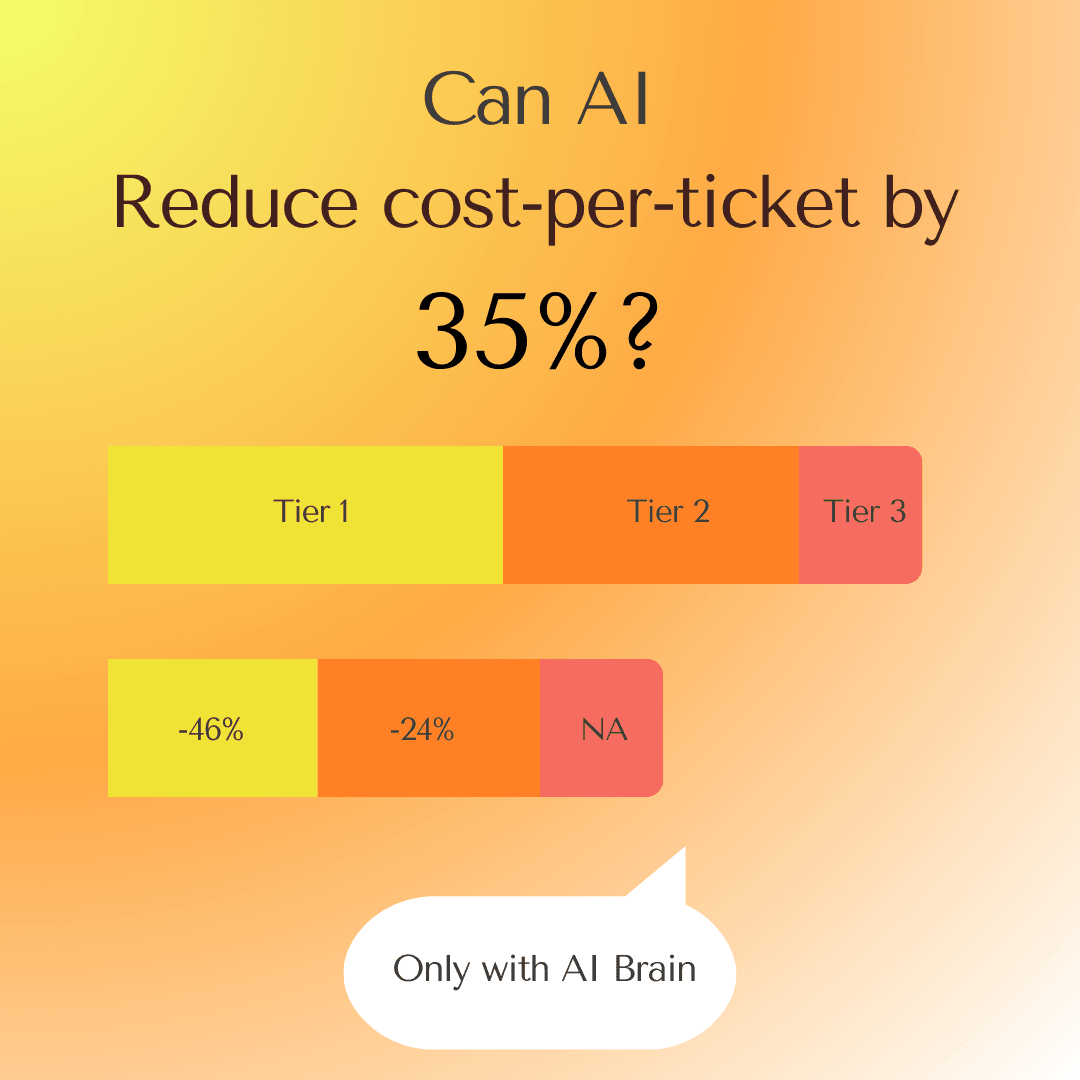
Rather than thinking about replacement, think about it in three tiers:
Tier 1 - Direct Savings (Months 1-3): AI handles the highest-volume, lowest-complexity tickets. You can safely reduce headcount or avoid planned hires equivalent to 15-25% of your current team.
Tier 2 - Efficiency Gains (Months 3-6): AI assists agents on complex tickets by pulling up relevant information, suggesting responses, and auto-filling forms. Each agent becomes 20-30% more productive on the tickets they do handle. This effectively frees up additional capacity.
Tier 3 - Strategic Redeployment (Months 6-12): With routine work handled and productivity up, you can redeploy agents to proactive support, customer success, retention calls, or upselling. This is where the real ROI often exceeds the cost savings from headcount reduction.
Research from McKinsey suggests that companies pursuing all three tiers see 2-3x the total value compared to those focused solely on headcount reduction.
What the Data Says About Agent Replacement
While every organization is different, industry data provides useful benchmarks:
- Companies deploying conversational AI typically see 20-35% reduction in required agent FTEs within the first year, according to Forrester research on AI in customer service.
- The average cost per ticket drops by 30-50% when AI handles the frontline, because AI-resolved tickets cost a fraction of agent-handled ones.
- Organizations that augment rather than replace report higher CSAT scores, because agents are freed up to spend more time on complex issues where empathy and expertise matter most.
These are not universal guarantees. They are directional benchmarks based on published research and aggregated case studies.
The Augmentation Argument: Why Keeping Agents Might Be Smarter
There is a growing body of evidence that the most successful AI deployments do not minimize the human workforce. They maximize it. Here is the logic:
AI handles volume. Humans handle value. When agents are no longer spending 40% of their day answering "Where is my order?" they can focus on the interactions that actually drive loyalty, retention, and revenue. A well-trained agent handling a complex billing dispute or a frustrated enterprise customer is worth far more than the cost savings from eliminating that role.
Agents become AI trainers. Your support agents know your product and your customers better than anyone. Redeploying some of them into roles where they review AI responses, identify knowledge gaps, and improve training data creates a feedback loop that makes the AI better over time.
Customer expectations are rising. According to Harvard Business Review, customers increasingly expect fast resolution for simple issues (AI's strength) but also expect more personalized, empathetic handling for complex ones (a human strength). Cutting too deep into your human team risks failing on the second expectation.
How to Present Agent Savings to Leadership
When leadership asks "How many agents can we replace?", here is a framework for a productive conversation:
- Lead with the math. Show the ticket volume, resolution rate, and capacity calculation. Be transparent about assumptions.
- Present three scenarios. Conservative (25% AI resolution), moderate (40%), and optimistic (55%). Show the corresponding agent savings for each.
- Quantify the redeployment value. If 3 agents are freed up and redeployed to retention, and each saves X customers per month at Y average lifetime value, the revenue impact often exceeds the cost savings.
- Set a timeline. Be clear that full savings take 6-12 months to materialize. Month one will not look like month six.
How Twig Delivers Agent Efficiency
Twig approaches agent efficiency from both sides: it resolves tickets autonomously where possible, and it makes agents faster and more accurate on the tickets that still need a human touch. Twig's AI assistant integrates directly into agent workflows, pulling context from your knowledge base, past tickets, and product data so agents spend less time searching and more time solving.
Decagon focuses on enterprise-scale automation, and Sierra emphasizes brand-aligned conversational experiences. Twig is built for support teams that want to see measurable efficiency gains quickly. Twig's analytics dashboard shows you exactly which ticket types AI is resolving, where agents are still needed, and where the next efficiency opportunity lies.
Conclusion
The honest answer to "How many agents can I replace with AI?" is: it depends, but probably 20-35% of current FTEs in the first year, with the potential for more as the system matures. The smarter answer is: replacement is only one part of the equation. The real value comes from combining AI-driven resolution with agent augmentation and strategic redeployment. Use the math framework in this article, set realistic expectations with leadership, and choose a tool like Twig that delivers both autonomous resolution and agent productivity gains. The companies winning at AI-powered support are not the ones with the fewest agents. They are the ones whose agents are doing the most valuable work.
Try Twig free — see how autonomous AI support works on your tickets
30-minute setup · Free tier available · No credit card required
Frequently Asked Questions
Will AI completely replace customer support agents?
No. AI does not replace agents on a 1:1 basis; it absorbs a percentage of ticket volume rather than eliminating roles wholesale. The most successful deployments augment the human team, letting AI handle volume while humans handle the complex, high-value interactions that drive loyalty and retention.
Will AI Reduce Support HeadcountHow do I calculate agent savings from AI deployment?
Use the formula: agents freed up = (total tickets x AI resolution rate) / agent throughput. For example, 10,000 monthly tickets with a 40% AI resolution rate and 800 tickets per agent frees up the equivalent of 5 agents of capacity.
Calculate AI Support ROIWhat tasks should AI handle vs. human agents?
AI handles volume and humans handle value: AI resolves the easy, high-volume tickets like password resets, order status checks, and FAQ-type questions, while agents focus on complex billing disputes and frustrated enterprise customers where empathy and expertise matter most.
How long does it take to see agent savings from AI?
Full savings typically take 6 to 12 months to materialize, progressing through three tiers: direct savings in months 1-3, efficiency gains in months 3-6, and strategic redeployment in months 6-12. Month one will not look like month six.
When AI Support Savings AppearRelated Pages
Weekly AI CX insights
How leading support teams deploy autonomous AI. One short email a week.
Related Articles
Decagon vs Sierra vs Twig: Which Is Most Secure?
Twig attaches source attribution and audit trails to every answer. Decagon and Sierra rely on enterprise controls. Which AI support is most trustworthy?
5 min readDecagon vs Sierra vs Twig: Best Helpdesk Coverage?
Twig connects 30+ data sources and runs across helpdesks. Decagon and Sierra favor custom enterprise stacks. Which has the best integration coverage?
5 min readDecagon vs Sierra vs Twig: Which Fits Mid-Market?
Decagon and Sierra are built for enterprise floors. Twig serves SMB and mid-market with no minimums. Which AI support platform fits a smaller team?
5 min read