Klarna AI Saved $40M on Support — Then Walked It Back
Klarna automated 67% of chats in 30 days and claimed $40M in hiring savings. A year later, they walked back the claims. What actually happened.
Key Takeaways
- ✓Klarna automated 67% of chats in 30 days — 2.3M conversations in month one
- ✓At launch ~700 agents of work and ~$40M saved; by Q3 2025, 853 agents and ~$60M
- ✓In May 2025 Klarna began rehiring humans for complex, nuanced cases
- ✓Deployment took ~6 months from design to launch
- ✓The playbook is replicable with platforms like Twig in weeks, not months
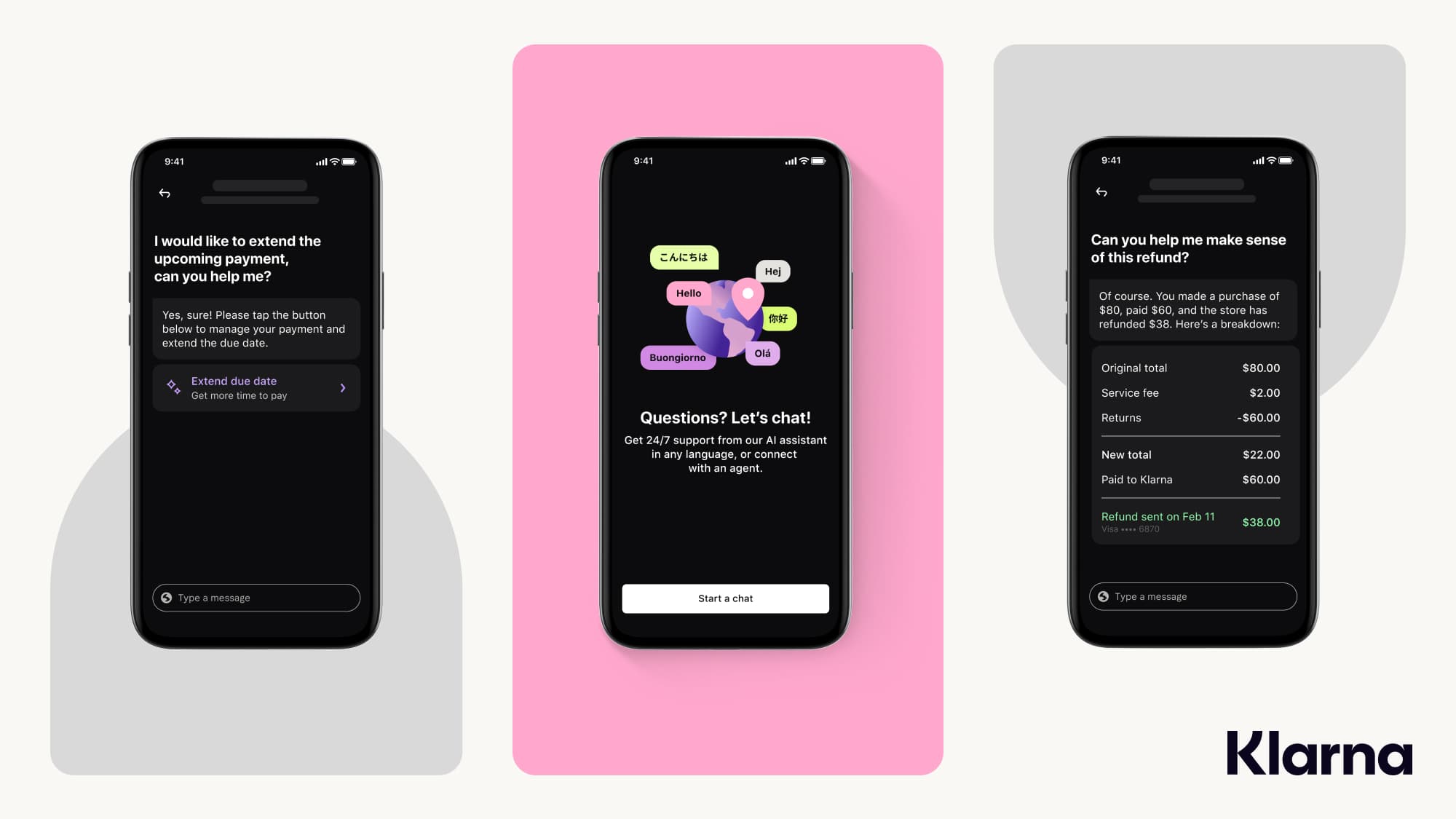
In February 2024, Klarna launched an AI-powered customer service assistant built in partnership with OpenAI. Within 30 days, it had handled 2.3 million customer chats — equivalent to the workload of 700 full-time agents — and automated 67% of customer conversations.
This guide is a deep analysis of the Klarna AI deployment. Not a news recap, but a breakdown of the numbers, the math, the architecture, the later walk-back in 2025, and — most importantly — the 3–5 concrete lessons your team can apply to your own support operation.
TL;DR: Klarna's AI deployment is one of the largest public AI customer support case studies. The story is not "AI replaces humans" — it's "AI scales tier-1 while humans move up the value chain." Here's what your team can take away.
The Headline Numbers
From Klarna's Feb 2024 press release and subsequent investor updates:
| Metric | Value |
|---|---|
| Chats handled in month one | 2.3M |
| % of total chats automated | 67% |
| Equivalent FTE workload | ~700 agents |
| Languages supported | 35+ |
| Avg resolution time (before → after) | 11 min → under 2 min |
| Repeat inquiries (a proxy for quality) | 25% fewer than before |
| Estimated cost avoidance | ~$40M/year |
Where the Numbers Stand in 2026
The table above is the February 2024 launch snapshot. Klarna kept reporting against it, and by Q3 2025 — its most recent public update — the efficiency figures had grown even as the strategy shifted:
| Metric | Feb 2024 (launch) | Q3 2025 (latest) |
|---|---|---|
| Work handled by AI | ~700 agents | ~853 agents |
| Estimated annual savings | ~$40M | ~$60M |
| Share of chats automated | 67% | ~two-thirds |
| Response time vs. pre-AI | — | 82% faster |
| Repeat issues vs. pre-AI | 25% fewer | 25% fewer |
| Customer NPS | — | 73 |
The headline efficiency numbers held up. What changed is the human side of the equation — Klarna started hiring agents back in May 2025, covered below.
The Math Behind 700 Agents
Klarna's "700 agents of work" framing got all the attention. Here's the actual calculation:
- 2.3M chats/month
- Average human handle time: ~11 minutes per chat (pre-AI baseline)
- 2.3M × 11 = 25.3M minutes = ~421,000 hours of work per month
- At 160 productive hours per agent per month: ~2,630 agent-equivalents of work
- At 67% automation: ~1,760 agent-equivalents of work handled autonomously by AI
So the "700 agents" figure isn't 700 agents displaced by AI. It refers to the additional agents Klarna would have needed to hire to handle that volume during a growth phase. They avoided hiring, not laid off — an important distinction.
What Klarna Actually Built
The system has four main components:
1. A GPT-4-class Language Model
OpenAI as the underlying model. Klarna tuned prompts and system instructions extensively for banking/BNPL-specific contexts.
2. Direct API Integration with Klarna Systems
Account data, transaction history, payment schedules, and refund processing all accessible through internal APIs. The AI can read customer data and take actions (reschedule payment, issue refund) without handing off to a human.
3. Knowledge Base with Grounding
Klarna's help center, policy docs, and past ticket resolutions form the grounding corpus. The AI retrieves relevant context from these before generating answers — reducing hallucination risk.
4. Escalation Logic
Low-confidence cases and complex queries route to human agents with context attached. Klarna doesn't disclose exact thresholds, but public statements suggest ~30% of tickets still escalate.
Deployment Timeline
Klarna hasn't published a full timeline, but based on industry reporting and conference talks:
- ~August 2023: Project kickoff, internal team assembled
- ~Sept–Nov 2023: Model selection, prompt engineering, integration design
- ~Dec 2023: Internal alpha testing with live Klarna support data
- ~Jan 2024: Limited beta rollout, human-in-loop review
- February 2024: Public launch
Total time from kickoff to launch: ~6 months. Klarna had direct engineering access to OpenAI and a large dedicated team — your timeline is likely shorter with off-the-shelf platforms.
The 2025 Walk-Back
In May 2025, Klarna publicly reversed course and began rehiring human agents after customers complained about generic answers and the AI's inability to handle complicated, nuanced cases. CEO Sebastian Siemiatkowski admitted the company had cut too far — "what you end up having is lower quality" — and committed to an "Uber-type" model where a customer can always reach a human. Reported reasons:
- Hallucinations on edge cases degraded quality for a slice of conversations
- CSAT dropped on complex / emotional tickets even when AI gave correct answers
- Compliance concerns around AI autonomously handling disputes and account closures
- The "AI replaced 700 agents" framing was misleading and drew scrutiny
Klarna's course correction:
- Reintroduced human agents for disputes, fraud, and hardship cases — recruiting "highly educated students, professionals and entrepreneurs" for flexible remote roles
- Tightened confidence thresholds (AI refuses more readily on ambiguous queries)
- Improved escalation handoffs so humans pick up with full context
This second chapter is as important as the launch. It shows that over-automation is a real failure mode — and that the right approach is AI for tier-1, humans for the complex 20%. Tellingly, Klarna kept the AI doing the work of 853 agents while adding humans back: the lesson isn't "less AI," it's "AI plus a guaranteed human option."
Lessons for Your Team
Lesson 1: Content quality caps resolution rate
Klarna invested heavily in cleaning up their help center before launch. Without clean, consistent policy docs, the AI would have hallucinated or given conflicting answers. Budget 1–2 weeks minimum for content cleanup before any deployment.
Lesson 2: Start in human-review mode
Klarna's beta period (Jan 2024) ran in human-review mode — every AI response reviewed before sending. This caught edge cases and let the team refine prompts iteratively. Skip this step at your peril.
Lesson 3: Escalation quality > automation rate
The gap between "AI handled 67%" and "AI handled 67% well" is enormous. Klarna's subsequent walk-back was driven by low quality on the escalated tier, not by failing to automate more. Optimize for quality of escalation handoff.
Lesson 4: Don't market "AI replaces agents"
Both the customer narrative and the investor narrative fared better when Klarna reframed from "AI replaced 700 agents" to "AI lets our agents handle complex cases while tier-1 runs autonomously." The second framing is truer and avoids reputational risk.
Lesson 5: Plan for ongoing content maintenance
AI customer support introduces a new ongoing task — content hygiene. Assign an owner. Review weekly. Watch for AI confidence drops as signals of content gaps.
Can You Replicate Klarna's Approach?
Yes — and faster than Klarna did.
Without the custom build: Platforms like Twig, Intercom Fin, and Decagon productize the architecture Klarna built in-house.
Timeline with a platform:
- Week 1: Content audit, integration setup
- Week 2: Human-review mode pilot, prompt tuning
- Week 3: Limited autonomous rollout on tier-1 queries
- Week 4: Expanded rollout, monitoring
Most teams we've worked with go from zero to 50%+ autonomous resolution in 4–8 weeks, not 6 months. The tradeoff: less customization than Klarna's bespoke build, but also far lower cost and risk.
See how Twig replicates the Klarna playbook →
Cost-Savings Calculator Logic
Applied to your team:
- If you handle X tickets/month and your average human handle time is Y minutes
- Total monthly support hours = X × Y / 60
- At 67% automation (Klarna's benchmark), AI handles X × 0.67 tickets/month
- Hours saved per month = (X × 0.67 × Y) / 60
- At $25/hour fully-loaded agent cost, monthly savings = hours saved × $25
- Annual savings = monthly savings × 12
Example: 50K tickets/month × 11 min / 60 = 9,166 hours. 67% automation = 6,141 hours saved/month. At $25/hr = $153K/month = $1.84M/year in capacity freed up.
Your mileage varies based on automation rate, content quality, and ticket complexity — but this is the math. It's why every fintech, ecommerce, and SaaS leader is running this calculation in 2026.
Common questions are answered in the FAQ below.
Get your own AI Receptionist now
Free 15-day trial · From $49/mo · No credit card
Frequently Asked Questions
How did Klarna automate customer service with AI?
Klarna built a GPT-4-class assistant with OpenAI, integrated it with its account and transaction APIs, grounded responses in help-center content, and routed low-confidence or complex cases to human agents.
How much money did Klarna save with AI support?
Klarna estimated ~$40M/year in avoided hiring costs at launch in 2024. By Q3 2025 it reported the assistant doing the work of 853 agents and ~$60M in annual savings. These are cost avoidance during growth, not layoffs.
How long did Klarna's AI take to deploy?
Roughly 6 months from kickoff to public launch in February 2024. Off-the-shelf platforms can get you live in 4–8 weeks.
What AI technology does Klarna use?
A GPT-4-class model from OpenAI with custom prompt engineering, direct API integrations to Klarna's backend, and a RAG-style knowledge-grounding system.
Can other companies replicate Klarna's AI success?
Yes, and faster. Platforms like Twig, Intercom Fin, and Decagon productize the architecture Klarna built custom. Expect 4–8 weeks to reach 50%+ autonomous resolution with strong content and proper deployment.
Related Pages
Weekly AI CX insights
How leading support teams deploy autonomous AI. One short email a week.
Related Articles
Decagon vs Sierra vs Twig: Which Is Most Secure?
Twig attaches source attribution and audit trails to every answer. Decagon and Sierra rely on enterprise controls. Which AI support is most trustworthy?
5 min readDecagon vs Sierra vs Twig: Best Helpdesk Coverage?
Twig connects 30+ data sources and runs across helpdesks. Decagon and Sierra favor custom enterprise stacks. Which has the best integration coverage?
5 min readDecagon vs Sierra vs Twig: Which Fits Mid-Market?
Decagon and Sierra are built for enterprise floors. Twig serves SMB and mid-market with no minimums. Which AI support platform fits a smaller team?
5 min read