Chatbots vs Conversational AI: What's the Difference?
Chatbots = rule-based scripts. Conversational AI = NLP + ML for context-aware responses. The real differences in capability, cost, and resolution rate.
Key Takeaways
- ✓Chatbots excel at simple, rule-based interactions and FAQs
- ✓Conversational AI understands context and learns from interactions
- ✓Conversational AI achieves 70-85% resolution rates versus 40-50% for chatbots
- ✓Implementation costs for conversational AI are 2-3x higher than chatbots
As businesses increasingly adopt artificial intelligence to improve customer interactions, two commonly used terms—chatbots and conversational AI—often cause confusion. While both technologies aim to facilitate automated communication, they differ significantly in capability, intelligence, and user experience. Understanding these differences is crucial for organizations looking to enhance customer support and engagement.
What are Chatbots?
TL;DR: Chatbots operate on rule-based scripts and decision trees, handling simple FAQs and transactional requests. Conversational AI leverages natural language processing and machine learning to understand context, learn from interactions, and provide personalized responses. Conversational AI achieves 3-4x higher resolution rates compared to traditional chatbots.
Key takeaways:
- Chatbots excel at simple, rule-based interactions and FAQs
- Conversational AI understands context and learns from interactions
- Conversational AI achieves 70-85% resolution rates versus 40-50% for chatbots
- Implementation costs for conversational AI are 2-3x higher than chatbots
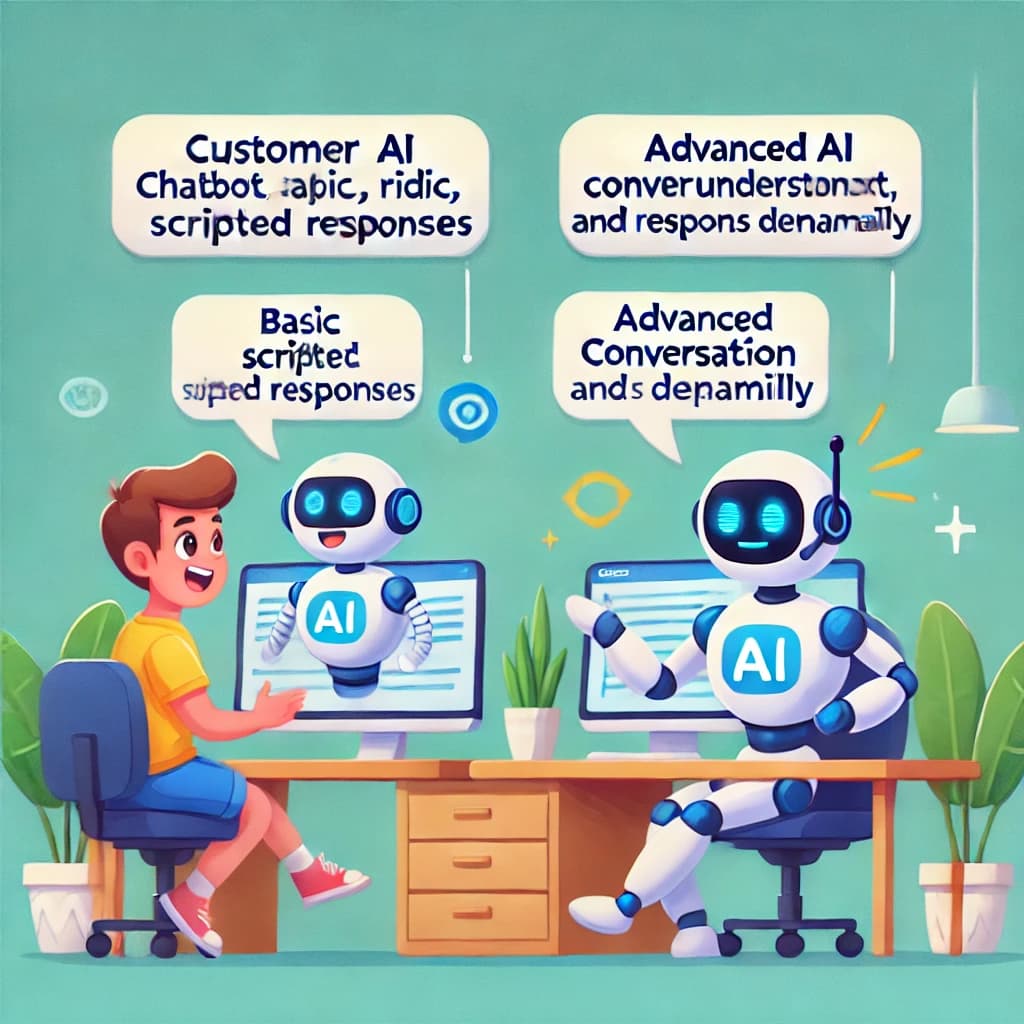
Chatbots are rule-based programs designed to simulate human-like conversations using predefined scripts and decision trees. They typically handle basic inquiries and follow structured workflows to respond to customer queries.
- Scripted Responses: Chatbots rely on predefined responses and keyword detection.
- Limited Context Awareness: They struggle with maintaining conversation history.
- Best for Simple Tasks: Commonly used for FAQs, order tracking, and appointment scheduling.
Learn more about chatbot basics at https://www.ibm.com/topics/chatbots.
What is Conversational AI?
Conversational AI is an advanced form of AI-powered communication that uses natural language processing (NLP) and machine learning (ML) to understand, interpret, and generate human-like responses.
- Contextual Understanding: It remembers previous interactions and adapts to user input.
- Personalization: Uses past interactions to provide more relevant answers.
- Omnichannel Support: Works across chat, voice, and messaging platforms.
Explore conversational AI technology at https://cloud.google.com/conversational-ai.
Key Differences Between Chatbots and Conversational AI
1. Intelligence and Adaptability
- Chatbots: Operate based on rules and scripted logic.
- Conversational AI: Continuously learns from interactions to improve responses.
2. Language Processing Capability
- Chatbots: Recognize keywords but often misunderstand complex phrasing.
- Conversational AI: Uses NLP and sentiment analysis to understand intent and tone.
3. Scalability and Use Cases
- Chatbots: Suitable for handling structured, repetitive queries.
- Conversational AI: Scales to manage dynamic, multi-turn conversations.
Learn how businesses are integrating AI for enhanced customer support at https://www.salesforce.com/products/service-cloud/.
Which One is Right for Your Business?
When choosing between chatbots and conversational AI, consider factors like customer needs, scalability, and complexity.
- For Simple Interactions: Chatbots work well for basic FAQs and transactional queries.
- For Personalized Support: Conversational AI provides a more interactive and human-like experience.
Discover the latest trends in AI-driven customer service at https://www.forrester.com/research/conversational-ai.
Future of AI-Driven Conversations
As AI technology advances, the line between chatbots and conversational AI continues to blur. Future developments include:
- Improved NLP models for deeper comprehension
- Integration with voice assistants and IoT devices
- Enhanced multilingual support for global customer interactions
Stay updated on AI-driven innovations at https://www.mckinsey.com/business-functions/mckinsey-digital/our-insights.
Conclusion
While chatbots provide basic automation for structured queries, conversational AI offers more intelligent, adaptable, and natural interactions. Businesses should evaluate their needs and select the right solution to optimize customer engagement and support.
For more insights into AI-driven customer interactions, visit https://www.gartner.com/en/insights/artificial-intelligence.
Get your own AI Receptionist now
Free 15-day trial · From $49/mo · No credit card
Frequently Asked Questions
When should you use chatbots versus conversational AI?
Chatbots work well for simple interactions like basic FAQs and transactional queries, while conversational AI is better suited for personalized, dynamic, multi-turn conversations that need contextual understanding.
How much more expensive is conversational AI than chatbots?
Implementation costs for conversational AI are 2-3x higher than chatbots, reflecting its use of natural language processing and machine learning rather than predefined scripts.
What resolution rates do chatbots versus conversational AI achieve?
Conversational AI achieves 70-85% resolution rates versus 40-50% for chatbots, roughly 3-4x higher than traditional rule-based chatbots.
How Chatbots Evolved in 5 YearsWhat is the difference between conversational AI and generative AI?
This post focuses on chatbots versus conversational AI, where chatbots are rule-based and conversational AI uses NLP and machine learning to understand context and generate human-like responses.
Conversational AI vs Generative AIRelated Pages
Weekly AI CX insights
How leading support teams deploy autonomous AI. One short email a week.
Related Articles
AI Support Vendors 2026: Only 5 Worth Demoing
5 AI customer support vendors worth demoing in 2026 — Decagon, Sierra, Forethought, and 2 more. $15.12B market, 56% AI-handled.
9 min readWhat Are AI Hallucinations in Customer Support?
AI hallucinations are false information generated by AI systems, posing major risks to customer support accuracy and brand reputation.
11 min readHow long does AI support implementation actually take?
AI support implementation ranges from 30 minutes to 90 days, depending on platform architecture, training requirements, and integration complexity.
10 min read